
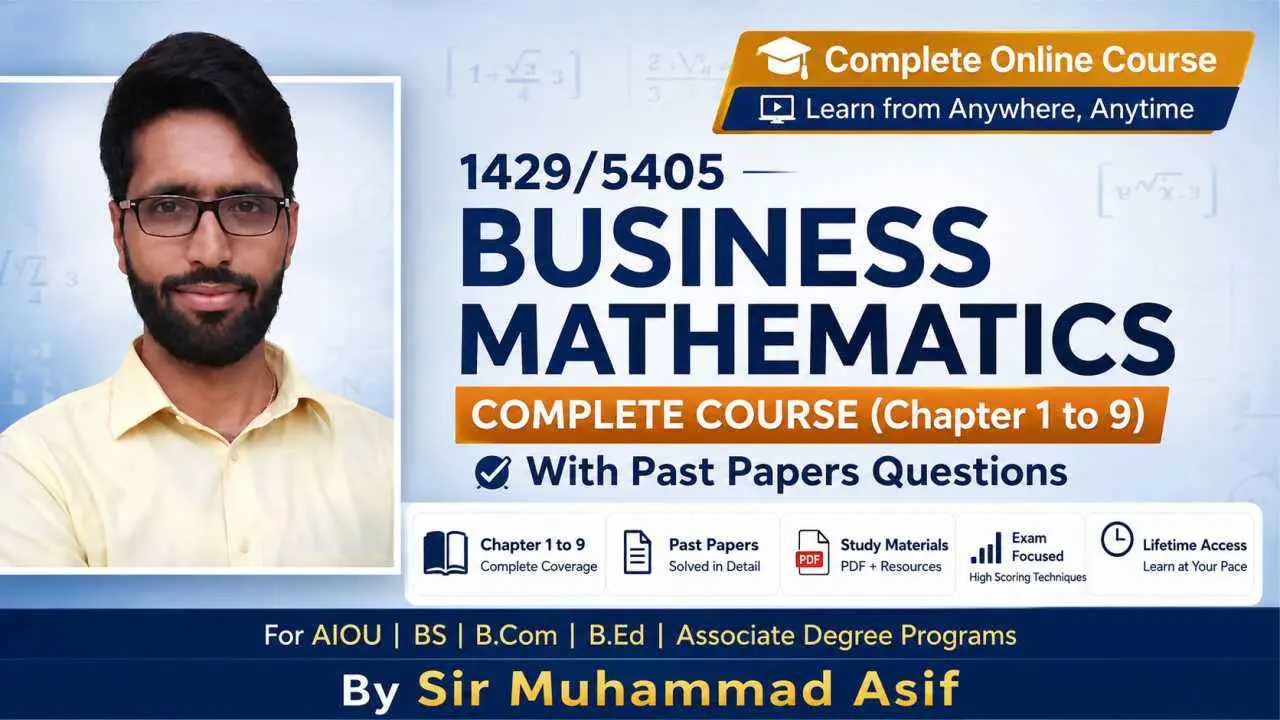
1429/5405 Business Math Complete Course

Wishlist Share

About Course

This course (Code: 1429 / 5405) is offered by the Department of Mathematics, Allama Iqbal Open University (AIOU), Islamabad. It is designed to develop and strengthen the fundamental mathematical concepts required for the study of Business and Social Sciences at the undergraduate level.

The course is organized into 9 units covering the following topics:

  1. Probability Theory – Basic concepts, rules, independent/dependent events, conditional probability
  2. Random Variables – Discrete & continuous variables, probability distributions and their properties
  3. Equations – First and second-degree equations, inequalities, absolute values, coordinate geometry
  4. Linear Equations – Characteristics, graphing, slope, intercepts, and different forms of straight lines
  5. Matrices – Matrix operations and their applications in business problems
  6. Determinants and Inverses – Properties and applications in business and finance
  7. Derivatives – Rate of change, differentiation concepts and rules
  8. Partial Derivatives – Properties, theorems, cost functions, and profit maximization
  9. Optimization – Minimization of cost and maximization of profit and revenue

Course Objectives:

  • Develop an understanding and appreciation of Mathematics among students
  • Present material in a motivating way to encourage higher-level study
  • Build the ability to apply mathematical concepts in real business situations

This course is suitable for students enrolled in Business, Commerce, or Social Sciences programs seeking to build a strong mathematical foundation for practical and professional use.

Show More

Course Content

Chapter 1: Probability Theory
📝 Chapter Summary: This chapter introduces the fundamental concepts of Probability Theory as a foundation for Business Mathematics. Students will explore how probability is used to analyze uncertain situations and make informed decisions in business and social sciences. The chapter begins with the basic building blocks of probability including sample spaces, sigma-fields, and probability measures. Students will then learn to identify and classify different types of events such as independent, dependent, mutually exclusive, and collectively exhaustive events using real-world examples and Venn diagrams. Moving forward, the chapter covers relative frequency as a method of estimating probability from data, followed by the seven essential rules of probability including complement, addition, and multiplication rules. Students will also learn the difference between marginal probability and joint probability, and how to use probability tree diagrams to visualize multiple outcomes. The chapter concludes with the laws of probability, focusing on conditional probability and dependent events with practical business applications. By the end of this chapter, students will be able to:Understand and apply basic probability concepts Classify events and calculate their probabilities Use probability rules to solve real business problems Interpret probability tree diagrams and frequency tables

  • 📘 Lesson 1: Introduction to Probability Theory & Sample Space
    17:24
  • 📘 Lesson 2: Events & Types of Events
    26:48
  • 📘 Lesson 3: Rules of Probability – Solved Examples
    28:01
  • 📘 Lesson 4: Coin Toss Probability & Tree Diagrams
    18:30
  • 📘 Lesson 5: Joint Probability – Children Groups Problem
    12:41
  • 📘 Lesson 6: Conditional Probability – Survey & Real Life Problems
    20:40
  • 📘 Lesson 7: Conditional Probability
    23:37
  • 📘 Lesson 8: Dependent Events & Without Replacement Problems
    29:20
  • 📘 Lesson 9: Self-Assessment Questions – Complete Solutions (Q1–Q10)
    32:53

Chapter 2 – Random Variables & Probability Distributions
This chapter introduces the concept of Random Variables and their role in Probability Distributions in Business Mathematics. Students will learn how to assign numerical values to random outcomes and analyze their probability behavior in real-world situations. The chapter begins with the definition of random variables and the key difference between discrete and continuous random variables. Students will explore how discrete random variables are obtained by counting while continuous random variables are obtained by measuring. Real business applications are also discussed including inventory management, quality control, banking and insurance. Moving forward the chapter covers discrete probability distributions and their properties. Students will learn how to construct probability distribution tables from frequency data and verify them using the fundamental property that the sum of all probabilities must equal 1. The chapter includes several important solved problems such as constructing distributions for false alarms, ocean storms, coin tosses and dice rolls. Students will also learn to find unknown constants (k and y) in probability distributions using the sum property. The chapter concludes with Self-Assessment Questions Q1 to Q10 covering all major topics with complete step-by-step solutions including binomial distribution, combinations (nCr), and ball selection problems. By the end of this chapter students will be able to:Define and classify random variables Construct discrete probability distributions from frequency data Apply the sum property to find missing values Solve ball selection and coin toss problems using combinations Apply binomial distribution to real problems📌 Quick Info for LMS Tutor Plugin: FieldValueChapter TitleChapter 2 – Random Variables & Probability DistributionsChapter Number2Course Code1429/5405LevelBeginner to IntermediateRelated CourseBusiness Mathematics – AIOU

Chapter 3 – Equations
Chapter 3 covers equations and inequalities, focusing on solving first-degree (linear) equations and second-degree (quadratic) equations using multiple methods. Topics include solving first-degree equations in one variable through algebraic manipulation (including equations with brackets and fractions), solving quadratic equations using factorization, the quadratic formula, and the completing-the-square method. The chapter also covers inequalities, including linear inequalities, second-degree inequalities (solved via factorization and sign analysis to determine solution intervals), interval notation, and absolute value equations and inequalities. Real-world business applications such as mixture problems (e.g., concrete ingredient ratios) are also included.

Chapter 4 – Linear Equations.
Lesson 1 – Equation of a line: slope-intercept, point-slope, two-point form (Examples 10–15 + slope practice) Lesson 2 – Parallel/perpendicular lines + price-supply/price-demand equations & market equilibrium (Ex. 16–17) Lesson 3 – Mixed practice: finding line equations from varied given conditions (7-part solution set) Lesson 4 – Applied word problems: purchase price with sales tax/fees, demand from price equation, graphing demand Lesson 5 – Cost functions (fixed + variable cost) and linear sales-growth interpolation between two years Lesson 6 – Graphing linear equations via table of values + solving simultaneous linear equations graphically

Student Ratings & Reviews

No Review Yet
No Review Yet