
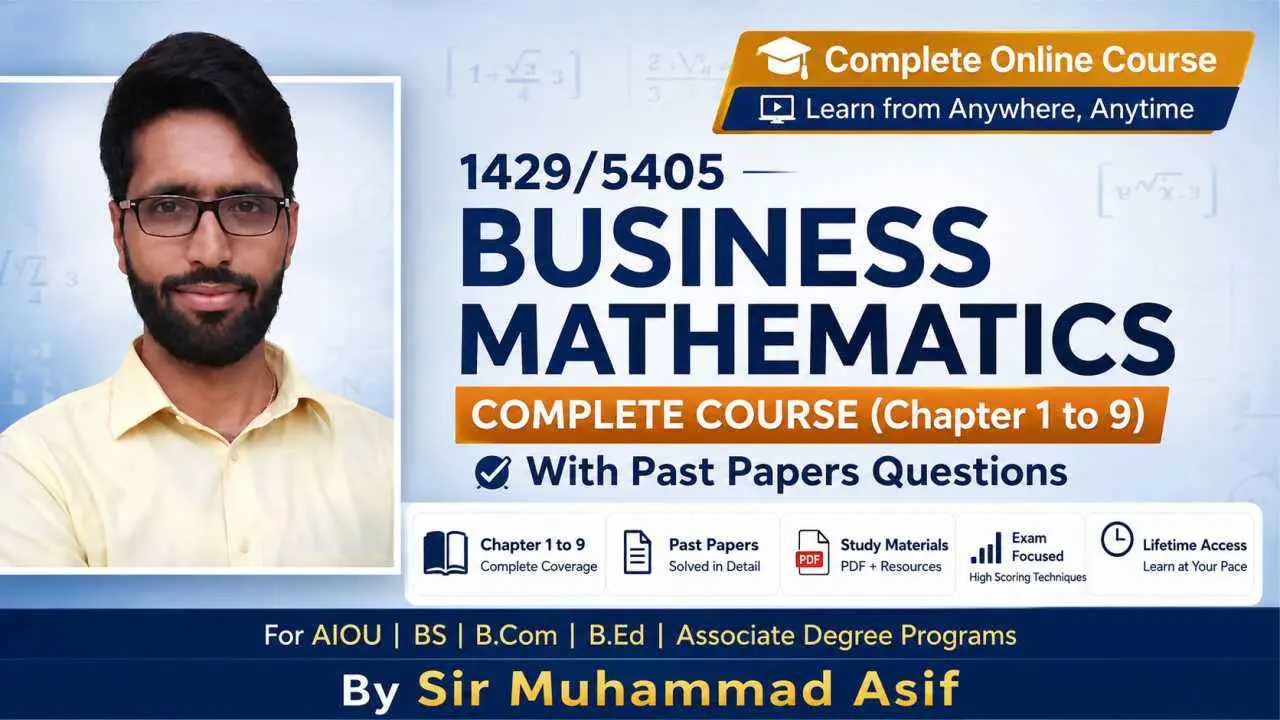
About Course
This course (Code: 1429 / 5405) is offered by the Department of Mathematics, Allama Iqbal Open University (AIOU), Islamabad. It is designed to develop and strengthen the fundamental mathematical concepts required for the study of Business and Social Sciences at the undergraduate level.
The course is organized into 9 units covering the following topics:
- Probability Theory – Basic concepts, rules, independent/dependent events, conditional probability
- Random Variables – Discrete & continuous variables, probability distributions and their properties
- Equations – First and second-degree equations, inequalities, absolute values, coordinate geometry
- Linear Equations – Characteristics, graphing, slope, intercepts, and different forms of straight lines
- Matrices – Matrix operations and their applications in business problems
- Determinants and Inverses – Properties and applications in business and finance
- Derivatives – Rate of change, differentiation concepts and rules
- Partial Derivatives – Properties, theorems, cost functions, and profit maximization
- Optimization – Minimization of cost and maximization of profit and revenue
Course Objectives:
- Develop an understanding and appreciation of Mathematics among students
- Present material in a motivating way to encourage higher-level study
- Build the ability to apply mathematical concepts in real business situations
This course is suitable for students enrolled in Business, Commerce, or Social Sciences programs seeking to build a strong mathematical foundation for practical and professional use.
Course Content
Chapter 1: Probability Theory
📘 Lesson 1: Introduction to Probability Theory & Sample Space
17:24📘 Lesson 2: Events & Types of Events
26:48📘 Lesson 3: Rules of Probability – Solved Examples
28:01📘 Lesson 4: Coin Toss Probability & Tree Diagrams
18:30📘 Lesson 5: Joint Probability – Children Groups Problem
12:41📘 Lesson 6: Conditional Probability – Survey & Real Life Problems
20:40📘 Lesson 7: Conditional Probability
23:37📘 Lesson 8: Dependent Events & Without Replacement Problems
29:20📘 Lesson 9: Self-Assessment Questions – Complete Solutions (Q1–Q10)
32:53
Chapter 2 – Random Variables & Probability Distributions
Chapter 3 – Equations
Chapter 4 – Linear Equations.
Student Ratings & Reviews

No Review Yet